
Duck Eggs Not Hatching? Relative Humidity Could Be The Problem
Spring arrives with its promise of new life. The daffodils are in flower and lambs are frolicking in the fields.
Ducks have started to lay and you fill your incubator with eagerness and anticipation. You candle your eggs periodically — first at around seven days to check they are fertile and subsequently to check development. Your ducklings are developing well, you can see them moving and growing and you excitedly get everything ready for their arrival.
Three days before due date you stop turning and increase the humidity in readiness for hatch. You may see your eggs move, but hatch day comes and goes and your ducklings don't arrive.
Whilst there can be a number of reasons why things go wrong everything may have gone right apart from the time of year.
Why Relative Humidity Matters When Incubating Duck Eggs
At Applebrook Ducks, despite running our incubators dry prior to raising humidity for hatch, we have always had difficulty with humidity being too high — causing the air cells in our developing eggs to be too small and the ducklings to drown in shell prior to inner pip.
We have a brook on site and are in a dip surrounded by trees, and I had thought these factors elevated our localised atmospheric humidity. Although this may be the case we always have greater success with hatching later in the season (from May onwards), so I concluded there might be something else going on.
The 'something else' is relative humidity; i.e., the fact that colder air holds less moisture than warm air — meaning that unless you have a consistently cosy house (which we don't!) the water developing eggs should lose has nowhere to evaporate to.
How to Check Duck Egg Air Cell Development During Incubation
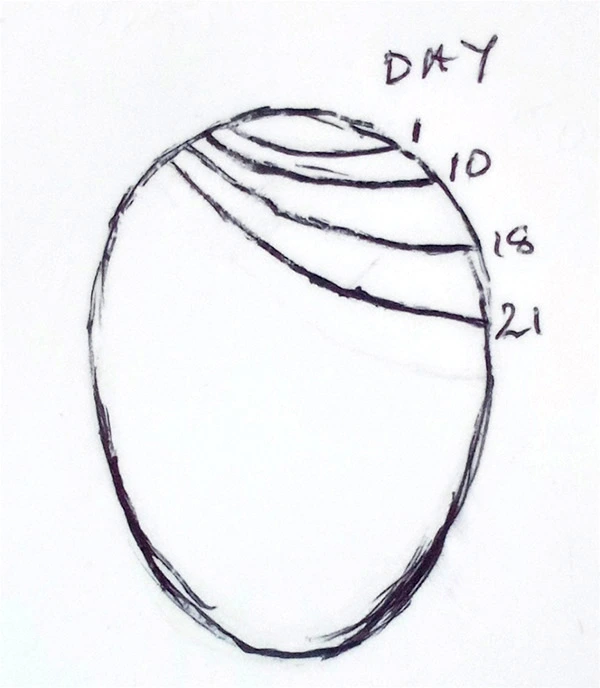
I now religiously check air cell development using the sketch below as a guide (some people weigh their eggs to calculate water loss). Unfortunately, if at ten days the air cells are too small (close to day 1) I've found it may already be too late and the ducklings are unlikely to successfully hatch.
The Effect of Weather on Relative Humidity
The first seven days of incubation are crucial. I hatched two Call ducklings this year on 30th March, with incubation starting on 4th March, but have failed to hatch more (there are currently eggs in the incubator looking good for hatch next week so fingers crossed). When I checked temperatures for March 2026 in our area I discovered that although temperatures from 4th March weren't particularly high they didn't dip below about 7 degrees centigrade until 12th March — in contrast to the rest of March when temperatures routinely dipped towards zero degrees. See image below:

How to Fix Duck Eggs Not Hatching Due to High Humidity
So in conclusion if, like us, you lose ducklings early in the year because their air cells are too small you could try:
- running your incubator dry until lockdown (if you don't already do so)
- relocating your incubator to a consistently warmer (but not humid) room
- watching the weather forecast and, if possible, starting incubation when temperatures are not forecast to dip — or simply waiting until a little later in the season when the weather is warmer.
Our two 'lucky ducklings' who hatched on 30th March, at two weeks old:

Comments
Be the first to leave a comment